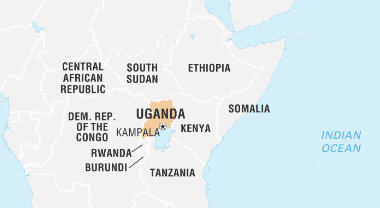
Uganda borders five countries: Kenya, South Sudan, the Democratic Republic of the Congo, Rwanda, and Tanzania.
Uganda has the world’s second youngest population in the world. The median age in Uganda is 15.7 years.
There are at least 32 languages spoken in Uganda. The official languages are English and Swahili. Ganda is also commonly used.
Uganda is the eighth most populated countries in Africa with a population of almost 50 million. It is also one of the fastest growing countries in Africa.
Three major ethnic groups in Uganda are the Baganda, Banyankole and Basoga People.
Many Ugandans live outside of the country in the United States and United Kingdom and are part of what is known as the African Diaspora.
Uganda is 7th in the list of African countries that receive the most remittances from expatriates living abroad.
The grey crowned crane is the national animal of Uganda and is featured on the national flag.
Uganda has been listed as one of the world’s most physically active nations by the World Health Organization.
Uganda is home to Lake Victoria, Africa’s largest natural lake and the world’s largest tropical lake.
25% of the Ugandans live in cities like Kamapala (the capital) or others urban areas like Nansana, Ssabagabo, Mukono, Gulu, Masaka, Lira, Mubende, Entebbe, Jinja, and Kitgum.
Urban areas often contain large numbers of mainly younger people—usually many more men than women—who have come to town seeking whatever work they can find.
Much of Uganda’s population work as subsistence farmers who grow crops such as cassava (also known as yuca or manioc), plantain, maize, sugar cane, sweet potatoes, beans, bananas, sorghum and rear animals.
The number of Ugandans living below the poverty line dramatically decreased from 31 percent in 2006 to 19 percent in 2013.
Many Ugandans lack access to electricity, healthcare and modern sanitation services, education, and adequate nutrition.
The leading causes of poverty in Uganda have been associated with the high proportion of workers in the agriculture sector and low number of skilled laborers, the lack of safety net programs, disease, and high infant mortality rates.
The borders of modern Uganda reflect a long period of colonization and were drawn arbitrarily encompassing very different populations with different cultural, linguistic, and historical traditions.
After visiting for the first time, British Prime Minister called Uganda “the pearl of Africa” and that nickname continues to be embraced by Ugandans and the world.
Many South Asians (Indians, Pakistanis, and Bangladeshis) immigrated from other parts of the British Empire to Uganda in the 19th and 20th centuries
Ugandan coffee is an important part of the agricultural economy and is sought after around the world.
Uganda obtained independence from Britain on October 9, 1962.
To preserve its beauty and biodiversity, much of Uganda has been placed in national parks including Murchison Falls National Park, Queen Elizabeth National Park, Bwindi Impenetrable Forest, Mgahinga Gorilla National Park, and Ruwenzori Mountains National Park.
The 1991 Investment Code offered incentives to foreign investors and created the Uganda Investment Authority to make it easier for potential investors to do business in the country. Since then the government has pursued policies of divestiture, privatization, and currency reform.
Tourism is the third most important contributor to the Ugandan economy after coffee and cotton exports.
 KSUganda